Law firm specialising in employment law
and social security law.
Law firm specialising in employment law
and social security law.
When an employer wants to recruit staff, the first step to take is to choose the contract that will govern the employment relationship.
And this is not always easy.
Under French employment law, there are many different types of contract, each with its own rules, conditions of validity and procedures for conclusion.
It's not always easy to find your way around!
In this special ‘contract’ section, we'll look at how to distinguish between the different types of contract so that you can choose the right legal framework for your employment relationship from the outset, as well as the most common clauses that can be included in an employment contract.
The law does not provide a definition of an employment contract.
However, it is possible to refer to doctrine and case law, which have defined an employment contract as a contract under which a person undertakes to work for and under the direction of another person, in return for remuneration.
There are therefore three essential elements to an employment contract:
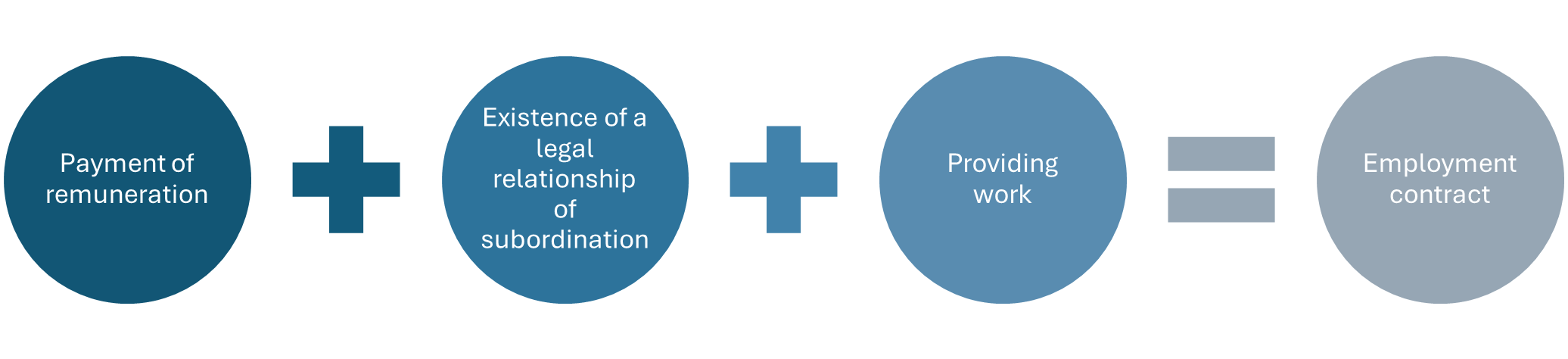
Without these three conditions, there is no contract. This is what distinguishes the employment contract from other related contracts, such as the contract for the provision of services, which binds two co-contractors without any link of subordination.
In addition, to be valid, an employment contract must comply with the rules governing the validity of contracts under ordinary law, as set out in article 1128 of the Civil Code:
Other obligations have gradually emerged.
With the exception of permanent full-time employment contracts, which do not require a written document, all other contracts must be in writing.
Progressivement d’autres obligations sont apparues.
Hormis les contrats de travail à durée indéterminée à temps complet, qui ne requièrent pas d’écrit, les autres contrats doivent nécessairement être constatés par écrit.

Be sure to check your collective agreement!
Most collective agreements require all open-ended employment contracts to be in writing.
The employment contract must be drawn up in French, even if the employee works abroad.
It must be drawn up in duplicate, dated and signed by both parties. The employer may not invoke against the employee the clauses of a contract that does not meet these conditions.
Open-ended contracts
The open-ended employment contract is the normal and general form of employment relationship.
It may be drawn up in any form that the parties decide to adopt. In principle, a verbal contract is therefore valid (Cass. soc., 4 December 2001 no. 99-43.324), unless it concerns intermittent work or part-time work.
If the contract takes one of these two specific forms, it must be in writing.
Subject also to the applicable provisions of collective bargaining agreements, which may contain a requirement for written contracts, it is recommended in practice to draw up a written employment contract in order to avoid any dispute over its scope and content, particularly if a trial period or other specific clauses are provided for.
Fixed-term contracts
Fixed-term contracts (CDDs) are governed by very precise regulations regarding the conditions under which they may be used. It may only be concluded for the performance of a precise and temporary task and only in certain specific cases, as set out in article L. 1242-2 of the Labour Code.
It has the following characteristics:
The contract must contain a certain number of compulsory details, listed in article L.1242-12 of the French Labour Code.
The list of compulsory information that a fixed-term contract must contain includes :
The employer must not only state the reason for concluding the fixed-term contract, but also, for example, specify the tasks requiring additional recruitment, or the nature of the activity and that of the job for which it is ‘common practice not to use open-ended contracts, all details making it possible to identify and verify the reasons given in the contract’ (Cass. Soc., 29 November 2007, no. 06-41.847).
However, the Court of Cassation has ruled that ‘the fact that a fixed-term contract states that it has been concluded to deal with a temporary increase in activity constitutes the precise reason required by Article L. 122-3-1 of the Labour Code’ (Cass. Soc., 28 September 2005, no. 04-44.823).
Defined purpose contracts
The defined purpose contract, also known as the ‘project contract’, is reserved for engineers and managers. It has a limited duration of 18 to 36 months and ends when the project for which it was signed is completed.
Apart from a few specific provisions, it is governed by the provisions of the French Labour Code relating to fixed-term contracts.
However, the company must be covered by an industry-wide agreement governing the use of this contract. Otherwise, a company agreement will have to be put in place, as provided for in article L.1242-2 6° of the Labour Code.

To find out more about fixed-term contracts with a defined purpose, click here.
Temporary employment contracts
Generally governed by similar provisions, a temporary employment contract differs from a fixed-term contract in that a temporary employment agency is involved upstream of the employment relationship. It is this company that will be the employer of the temporary employee, who will carry out his assignments within a company known as the ‘user’.
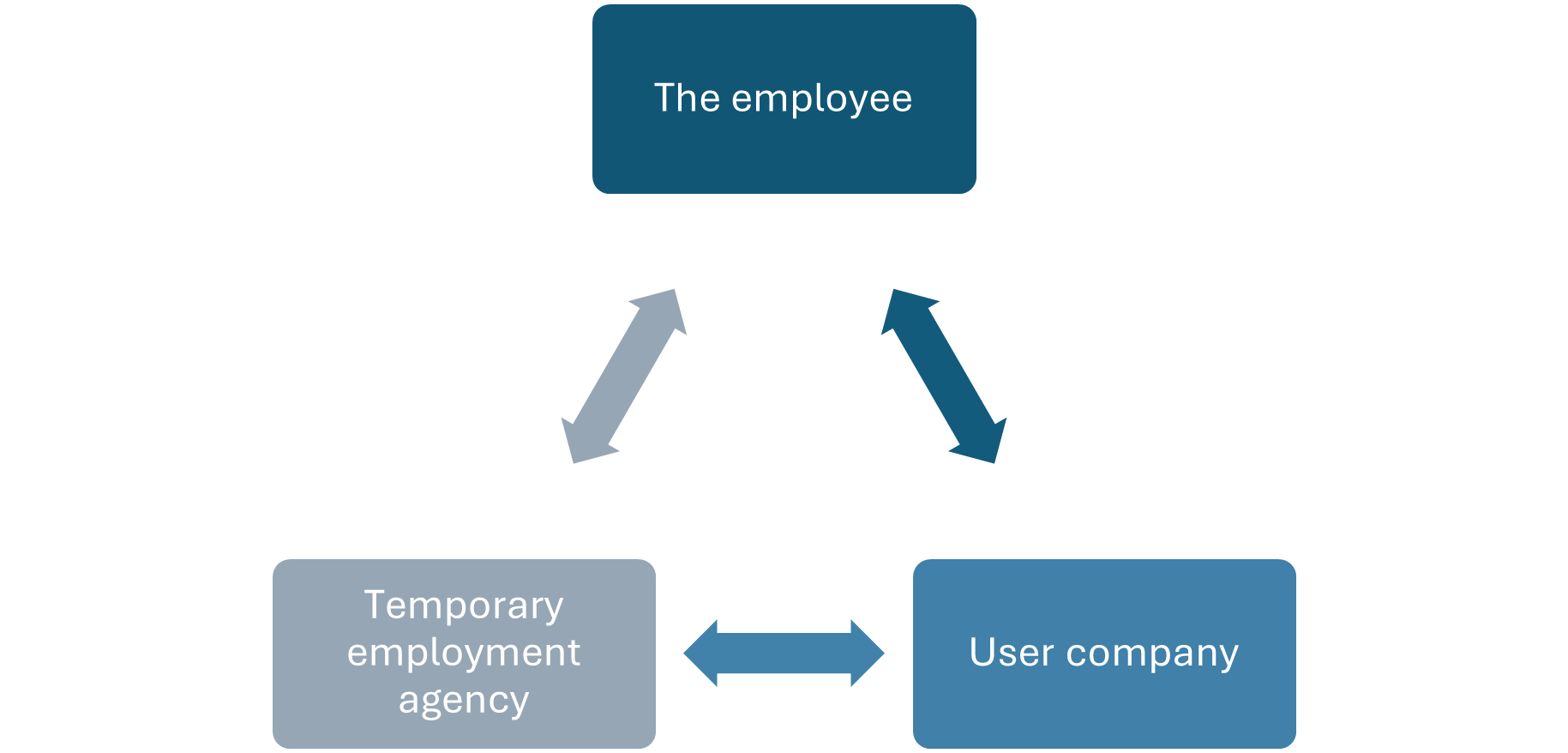
In any event, the contract may not be used on a permanent basis to fill a job related to the normal activity of the company, in accordance with Article L. 1251-5 of the French Labour Code.

The provisions relating to temporary work are specific!
To contact us, click here.
All employment contracts must include a certain number of common clauses, such as :
- Purpose ;
- The duration of the contract
- The terms and conditions of the contract (type of contract, employee duties, job classification, basic gross pay and any additional pay, working hours and/or duration, place of work).
These clauses may be supplemented by other clauses that are more specific to the characteristics and requirements of each type of contract and employment relationship.
These may include :
These clauses must comply with the provisions of public policy and those specific to them. Case law has also defined a number of conditions for certain clauses.
In most cases, the clause will also have to be justified in terms of the nature of the task to be performed, in accordance with articles L 1121-1 of the Labour Code and 1162 to 1164 of the Civil Code.