Law firm specialising in employment law
and social security law.
Law firm specialising in employment law
and social security law.
Are you an employer whose employee has declared an occupational illness? Do you not know how to deal with the situation? Are you unaware of the risks involved in declaring an occupational illness?
Then this article is for you.
An illness is said to be ‘occupational’ when it is the direct consequence of a worker's exposure to a physical, chemical or biological risk, or results from the conditions under which he or she carries out his or her professional activity.
There are two categories of illness that can be recognised under occupational illness legislation: ‘listed’ illnesses and ‘unlisted’ illnesses.
It is in employees' interests to have their occupational illness recognised and to receive daily allowances while they are off work.
First of all, unlike sick leave, there is no waiting period for receiving daily benefits in the event of an occupational illness.
Secondly, employees benefit from better compensation during their sick leave. Note: sick leave taken during the procedure for recognition of an occupational disease may be adjusted after the event if the disease is subsequently recognised as being of an occupational nature.
Daily benefits are paid throughout the period of incapacity for work, until the injury is fully recovered or consolidated. The daily allowance is paid to the victim by the primary health insurance fund, from the first day following the cessation of work following the accident, without distinction between working days and Sundays and public holidays.
Between the 1st and 28th day of absence from work, daily benefits are paid at 60% of the reference salary. From the 29th day onwards, daily benefits are increased to 80% of the reference daily salary (L.433-1, R.433-1 et R.433-3 of the Social Security Code), compared with 50% of the reference daily salary for simple illness over the entire period. Payment of compensation is subject to the fulfilment of two cumulative conditions: medically certified temporary incapacity to work and loss of earnings.
The employer is obliged to pay a minimum supplement to the daily allowance if the employee has at least one year's seniority on the date of the 1st day of absence, if the accident report was sent to the employer within 48 hours and if he or she is receiving daily allowances from the health insurance fund and is receiving treatment in France, the EEA or the EU. The employee is entitled to 90% of his gross pay for the first 30 days, then 2/3 for the following 30 days, after deduction of the daily allowance paid by the health insurance fund. These periods and/or amounts may increase depending on seniority or applicable collective bargaining provisions (L.1226-1, D.1226-1 et D.1226-2 the French Labour Code).
Finally, once the occupational nature of the illness has been recognised, the health insurance fund will cover 100% of all treatment related to the illness, on the basis of and up to the Social Security rates, with the exception of dental prostheses and certain medical devices, which are covered at 150% on the basis of Social Security rates and up to the actual cost.
Unlike an accident at work, an occupational disease is only declared by the employee. To do this, they must send the declaration of occupational illness, which is a CERFA drawn up by the occupational physician, and the initial medical certificate to the services of the fund to which they are attached.
It is very difficult to date the onset of the disease precisely. It may be (L.461-1 of the Social Security Code):
Under ordinary law, workers have 2 years in which to declare an occupational disease (L.461-1 of the Social Security Code):
All of these options are designed to make it easier to declare an occupational illness and enable workers to do so over a very long period.
In the first ‘classic’ case of recognition, the disease is presumed to be of occupational origin when it is contracted under the conditions mentioned in the table that designates it (L.461-1 of the Social Security Code).
In this case, each of the conditions set out in the table must be met. If the initial medical certificate is not sufficiently complete, the fund's medical officer may supplement it on the basis of the employee's medical file.
No, the fund's medical officer who analyses the claim is free to base his decision on the table of his choice. If the conditions of the original table are not correctly met, he may use another table if the employee meets all the criteria. However, the adversarial principle requires that the employer be informed before the fund makes its final decision.
If there is no table designating the illness from which the employee suffers, the illness may be recognised as being of occupational origin when it is established that it is essentially and directly caused by the victim's usual work.
To do this, two cumulative conditions must be met L.461-1 of the Social Security Code):
The basic procedure is governed by articles R.461-9 et R.461-10 of the Social Security Code.
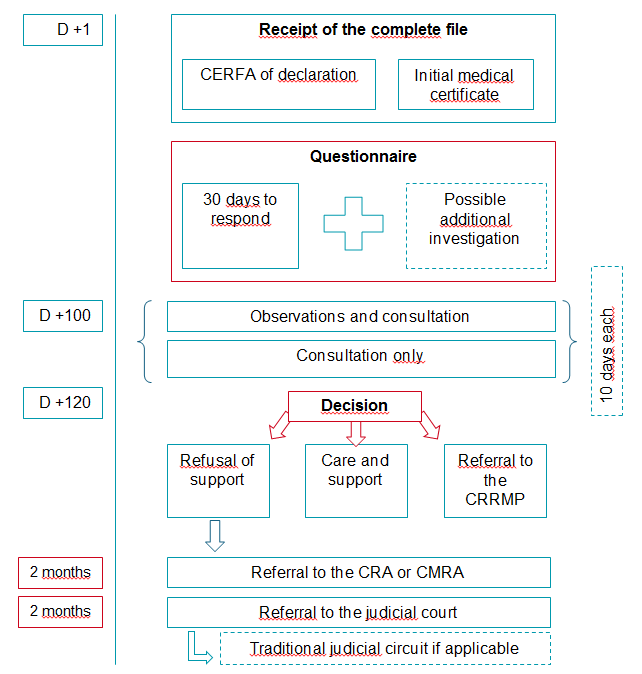
The fund is given an initial period of 120 clear days to rule on the occupational nature of the disease or to refer the matter to the CRRMP (in principle, only for diseases ‘outside the table’ or when all the conditions set out in a table are not fully met).
This period runs from the date on which the health insurance fund receives the declaration of the occupational disease, which includes the initial medical certificate, and the date on which the medical advisor receives the results of the additional medical examinations provided for in the tables of occupational diseases (where applicable). The fund sends a copy of the occupational disease declaration including the initial medical certificate to the employer and to the occupational physician.
During this initial 120-day period, the fund initiates investigations and, as part of this, sends a questionnaire to the victim or his representatives as well as to the employer. The questionnaire must be returned within 30 clear days.
At the end of its investigations, and after 100 clear days at the latest, the fund makes the file available to the parties, who then have 10 clear days to consult it and make their observations known. At the end of this period, the parties may consult the file without making any comments. The fund must inform the parties of these periods no later than 10 clear days before the start of the consultation period.
At the end of this procedure, the fund may issue a decision to cover or refuse to cover the costs, which will be notified to the worker no later than the 120th day.
The fund may also refer the matter to the CRRMP in two cases:
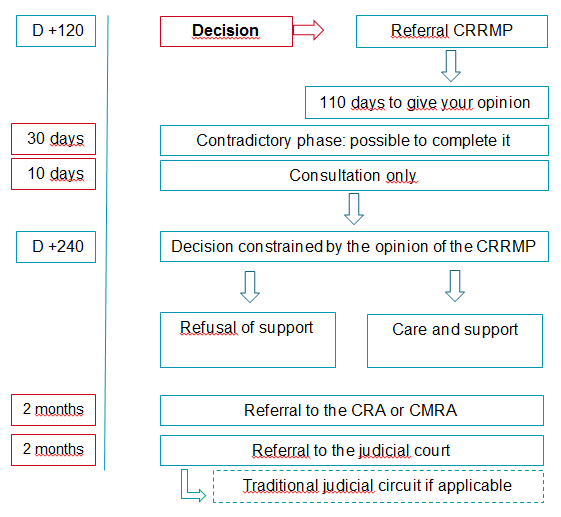
When the fund refers the case to the CRRMP, it has a further 120 clear days from the date of referral to rule on the occupational nature of the illness. The parties are informed.
The fund then makes the file available to the parties for a period of 40 clear days. During the first 30 days, the parties may consult the file, add any information they consider useful and make their observations known. The fund and the medical inspection department have the same period to complete the file. During the next 10 days, only the consultation and the formulation of observations remain open. The fund informs the parties of the deadlines for these different phases when it refers the case to the CRRMP.
The CRRMP gives its reasoned opinion to the fund within 110 clear days of the referral.
The fund immediately notifies the parties of the decision to recognise or refuse to recognise the occupational origin of the illness in accordance with this opinion.
If the fund refuses to cover the illness, the worker may wish to contest the decision.
The same will apply to the employer if the occupational disease is recognised by the fund despite the employer's objection, or if the employer is found to be at fault (when the employer is held responsible for the accident because of the exceptionally serious risks of which he could not have been unaware). The employer's interest in contesting will be assessed in the light of the impact of such recognition on the rate of occupational injury contributions (which depends on the accident rate within the company).
In this case, the party wishing to contest the decision must refer the matter to the CRA or CMRA within 2 months of being notified of the decision. The CRA or CMRA has 2 months to reach a decision. After this deadline, and in the absence of an explicit decision, the appeal is considered to have been implicitly rejected.
Once the preliminary appeal has been lodged, any party wishing to do so may refer the matter to the social division of the judicial court within two months of the decision, and will then enter the classic judicial circuit (judgement then appeal then possible appeal to the Supreme Court).
When the CPAM issues a decision to cover or refuse to cover a claim, the decision remains definitive for each of the parties, even if the decision is contested by the other party; this is known as the principle of independence of relations. In other words, if the employee contests the decision taken by the CPAM, the initial decision remains definitively in the hands of the employer. The same applies if the employer wishes to contest the decision.
In the case of medical appeals, the employer cannot have direct access to the medical file. He must appoint a doctor to receive the information, while respecting medical confidentiality. The employee, although not a party to the appeal, will be informed of this transmission.
Below is a summary of the procedure for recognising an occupational disease.
Below you will find a summary diagram of the procedure for recognizing an occupational disease after referral to the CRRMP.